
About the play How to Make a Woman
A Brief Context for the Start of How to Make a Woman
Caravan Theater started in 1963 as a two-summer project led by married co-founders, playwrights, and theater directors Stan Edelson, 34, and Bobbi Ausubel, 28. In a big, crowded yellow school bus, the couple, their young children and a group of actors “caravanned” across New England to perform their plays. Eventually, they found a permanent home in Cambridge, Massachusetts at Harvard Epworth Methodist Church. There, in Harvard Square, they spent over a decade performing plays by known playwrights, by Edelson, and later, by Ausubel. Importantly, they also had success with their company-created works. The common theme for all of their productions was what they called “socially relevant” theater. For more on the beginning of Caravan Theater, see here.
The Creation and Trajectory of How to Make a Woman
In January 1967 — a few years before the start of the Second Wave of the Women’s Movement in the U.S. — the cast, crew, and staff of this small, low-budget experimental theater, gathered in the home living room of co-founders Stan Edelson and Bobbi Ausubel. At that meeting, Bobbi proposed a unique idea: she wanted to create a play that would explore what it’s like to be a woman and how it differs from being a man.
Stan immediately understood the importance of a play focused on women’s oppression. Growing up, he watched his mother struggle with domestic solitude and constraints, which helped fuel his political activism. From that first meeting, he was committed to the project.
The group engaged in a complicated, intense discussion about Bobbi’s proposal, in which one participant, Joe Volpe, emerged as one of the project’s biggest supporters. At meeting’s end, the company agreed to an innovative plan: They would create a theater project focused on women.
This project eventually grew into the play How to Make a Woman—an original, ground-breaking, and biting commentary on growing up female and society’s denial of choices and opportunities for women. In the end, Caravan Theater would go on to have a highly successful, multi-year run of How to Make a Woman. The play was later recognized by Rosemary Curb, a feminist theater critic and academic, as the first play of the modern women’s movement.
First, a bit about the name “How to Make a Woman”: In the 1960’s, the phrase “make a woman” meant having sex with a woman. While the play was really about how society constructed limited roles for women, the title played on the double entendre and perhaps helped pique the public’s attention.
The play was shaped through months of improvisation with key members of the theater troupe. Theater director Bobbi Ausubel guided these exercises and urged her cast to draw on their personal and collective experiences to elucidate cultural assumptions about femininity. Joe Volpe supported and encouraged a physical movement style that was unique for the time, and that Bobbi was aiming for.
Playwright Stan Edelson attended all of the improvisations, never missing a single one. He then went off and transformed the group explorations into what Bobbi later called “a surprisingly-new, creative, ever-evolving script.” From the start, the play aimed “to ridicule rather than reinforce [existing] social beliefs” and reject “biological essentialism.” Stan’s script ultimately posed a central question: How does society “construct” and “position” women throughout their lives?1
Stan developed How to Make a Woman, set partly in a dress shop and partly in the homes of its two main female characters, Aili and Mary — played by actors Aili Paal Singer and Barbara Fleischmann MacKenzie-Wood. (Note: The name Mary was used, because Mary Rosenblum was the original actor during the improvisation period and in the first performance. Fortunately, actress Aili Singer, a very fine actress, is the only person who took part in creating the improvisations and also acted in all later productions of the play.) How to Make a Woman used the dress shop’s clothing choices to symbolize the roles women often played at different stages of their lives. Bobbi explained that How to Make a Woman showed how “the socialization of girls and women” fit them into predetermined gender roles.
The characters in the dress shop consisted of two male shop owners — played by Joe Volpe, David Klein, and later Peter Kovner. They were accompanied by a shop assistant named Mannequin, played by Ann Barkley. Together, using humor and physical movement, the three shop characters coaxed the two women customers into trying on dresses — that is, the different roles society offered them. In different scenes, the shop owners become archetypal male figures — the “Hunter” (the money-provider) and the “Wolf” (the pleasure-provider) — who control both the shop and the women’s lives.
Each time Aili and Mary tried on a new dress, they were swept into another prescribed version of constricted womanhood.2 In the second part of the script, the play explored the “formidable obstacles offered to women who rejected the mainstream subservient roles.” For a more detailed description of the play, see the below section Description of the Play How to Make a Woman and/or here.
By June 1967, How to Make a Woman was ready for its public premiere. Stan approached Club 47 (now known as Passim), located in Harvard Square, Cambridge, Massachusetts, and enticed them to host the first How to Make a Woman performances. Reflecting on the experience, Bobbi noted, “Early audiences enjoyed the show and clapped, but then returned home and forgot about it.” Behind the scenes, however, both American politics and public consciousness were on the brink of significant change, which soon catapulted Caravan and How to Make a Woman to new heights.
One day in 1968, while the Caravan cast rehearsed an updated version of the play, Joe Volpe rushed into the theater with surprising news: He’d heard that at the 1968 Democratic National Convention, held in Chicago, a group of women who were part of the protesting organization Students for a Democratic Society (SDS) left SDS to form a new organization called “Female Liberation.” Joe said the women were tired of being discounted and disrespected at SDS meetings.
Bobbi was shocked and wondered, “What does ‘liberation’ even mean? Are there other women who feel like I do, and are ready to make some noise about our experiences?” Soon Bobbi and the entire Caravan troupe realized their onstage work was paralleling a larger emerging political movement.
Over the next few years (1968-1972), while the Caravan troupe performed the play How to Make a Woman, Bobbi continued to refine the script as she grappled with her new awakening questions about gender. She updated dialogue, rearranged scenes, and adjusted characters based on insights from post-performance women’s groups, male allies, and audience feedback. She even hid in the ladies’ bathroom after performances to eavesdrop on candid post-show reactions, revising anything in the script she felt fell flat or provoked unintended laughter.3 4
Gradually, word spread about How to Make a Woman. Audiences began to pack the makeshift auditorium in their new home, the Harvard Square church, with up to 200 people at a time. They perched uncomfortably for 90 minutes on the hard, homemade wooden bleachers. Theater critics who had once dismissed the play as “ridiculously bad” began to praise the cast and give it rave reviews. Both male and female theater critics recognized the play’s value and cultural significance.
In addition to performances at the church, Caravan, under Stan’s guidance, expanded to offer Male/Female weekend workshops led by Stan and Bobbi. Stan later offered these workshops more publicly at the Cambridge Center for Adult Education, with a female co-facilitator, Lee Regal. At the same time, the How to Make a Woman play and workshops toured to East Coast universities.
Ultimately, How to Make a Woman, which performed on and off for four years, became Caravan’s “most successful show” and turned the company into “a center of feminist energy in Boston.”5
It grew, and it grew, and it grew… and it wasn’t because of the critics.Aili Paal Singer, Caravan actor
Post-Performance Discussion Groups
Caravan was unique in its approach to audience engagement. After each performance, viewers were invited to stay for group discussions on the play’s themes: gender roles and gender relations. At that time, in the 1960s and 1970s, some theaters held infrequent post-performance discussions in which a few audience members stayed to talk with the play’s director and/or actors. At Caravan Theater, the cutting-edge theme of How to Make a Woman, coupled with the evolving feminist political climate, led the post-show talks to organically become a significant part of the Caravan experience.
At the end of each performance, the entire cast stepped forward to take a bow. Then Bobbi invited audience members to continue the dialogue. Those post-show discussions soon became as significant as the play itself, with “half the audience, if not more” choosing to remain behind because, as Bobbi recalled, How to Make a Woman was an “a-ha!” moment for them. It was often their first introduction to thinking about gender roles. Stan, Bobbi, and the actors facilitated these passionate discussions.
Originally, men and women in the audience discussed the play together. But, as Bobbi explained, “the women wouldn’t talk, so we just decided to split them.” Men went with Stan and the male actors. Women went with Bobbi, the female actors, and other Caravan staff. In these separate men’s and women’s groups (sometimes a few women’s groups met at the same time), people felt free to grapple with their own personal experiences. This separation gave everyone the freedom to speak more openly, although some groups later reconvened for mixed-gender discussions.6
How to Make a Woman actor Barbara Fleischmann MacKenzie-Wood recalled that the group facilitators would start with simple questions, such as, “What did you think about the play? How did it stir you?” Or “How do you view your own life, because of this?” This prompted deeper conversations on the fundamental dynamics between men and women. Although the cast facilitated the groups, Barbara points out that “the conversation wasn’t really about us.” Instead, the real focus was on the audience’s reflections and what the play had awakened in them. Barbara remembers how “people were eager to share their feelings.” adding that it “hit at the right time,” empowering viewers to not only think about their personal experiences but to take action.7
How to Make a Woman actor Aili Paal Singer notes that the discussions allowed audience members “to question things, make comments, and to hear others say things they would never hear otherwise.”
According to How to Make a Woman actor David Klein, these post-show discussions were the heart of the production: “What’s important about this play is not whether it’s artistic or beautiful… it is that the audience changes their lives as a result of it, or at least thinks about their lives”8
These post-performance discussions at Caravan became some of the first consciousness-raising groups on the East Coast. As history shows, consciousness-raising groups in general played an important role in the Second Wave of the Women’s Movement in the U.S. It was in these groups that people began to understand the newly coined phrase, “the personal is political.”
As the national women’s movement gathered momentum, some inspired Caravan audience members, mostly women, returned again and again to see the show, and, in some cases, to lead the post-show conversations.9 Some audience members told Bobbi they had even started their own consciousness-raising groups. Caravan also joined the larger effort: they began distributing educational material, including the feminist pamphlet The Myth of the Vaginal Orgasm.
All this feminist energy was boiling up as other social justice movements were taking hold. In fact, the anti-Vietnam War protests were proliferating in Harvard Square. Male students at Harvard University and other Boston-area colleges were being drafted, so anti-war sentiment and revolutionary energy were running high.
“We performed the show even during the middle of the anti-war riots, when streetlamps right outside our theater were broken and tear gas went off. What a way to do theater! Alive! We were feeding and being fed.” — Bobbi Ausubel
Reactions from the Audience and Critics
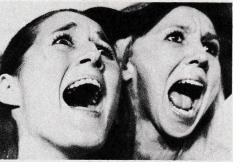
Peter Kovner, who saw many early productions of How to Make a Woman before joining the cast, noticed that audience reactions often split along gender lines. Women, he recalled, “were just so raucous and pleased and belly laughing,” while men, though they laughed, seemed to wonder, “Am I now going to be attacked, and can I leave the theatre alive?”10
Despite the show’s controversial reputation and some viewers’ initial wariness, How to Make a Woman built its following through passionate word of mouth. Aili recalled, “It grew, and it grew, and it grew… and it wasn’t because of the critics and reviews, it was the people that came to see what was happening.”
Students and professors recommended the play, which soon led to sold-out performances. In Cambridge, How to Make a Woman was not a typical theater piece; it was “unusual” and prodded people’s curiosity, with those in Cambridge asking, “What is Caravan Theater doing now? What are they saying in this play?”11
Barbara reflected that the play held up a mirror to both men and women: “It was a place where men and women could see themselves and see their lives being played out… very physical… very vocal.”
As its popularity soared in Harvard Square, the play also garnered critical praise. One 1970 reviewer, Laura Shapiro, wrote in the Boston Phoenix about “the play’s power” and how it “never [fell] into polemics… The stuff of it is fantasy and symbol, but the truths that [came] tumbling out [were] piercingly immediate.”12
Of course, the production’s boldness generated some alarm within the community. Aili recalled one evening when rumors spread that a policeman was checking the theater’s side door after a complaint of nudity and obscenity. “We thought, well, let him watch,” she said with a laugh.13
Peter described How to Make a Woman as “the hot show for a few years,” drawing crowds eager to see things “they wouldn’t normally see.” Many women returned multiple times, finding in the play “courage or some kind of strength.” David confirms that Caravan regularly sold out, saying they “sold that thing out forever,” and each revival continued to attract packed audiences.14
See here for a sample of newspaper articles and reviews about How to Make a Woman.
Am I now going to be attacked — and can I leave the theatre alive?A man in the audience, recalled by Peter Kovner
Experiences in Poland: International Theater Festival
Winky Belz, Technical Director Stan Edelson, Street Performance
Caravan became known internationally. It was invited to several international theater festivals. But the troupe only went to one because of a lack of travel funds. Caravan took How to Make a Woman to communist Poland for the 1971 International Polish Experimental Theatre Festival. They performed in a number of cities, all at the invitation and payment of the Polish government. They traveled on buses and trains, and slept in student dorms.
At every venue where they performed, only university students and faculty were allowed to attend; the performances were not open to the general public. From the start, the company’s American presence and feminist ideals stirred interest. Bobbi recalled, “They nearly broke down the theater doors to get in. Mostly because we were Americans, and they were thirsty to know about anything from outside of Poland. But in the end, the play’s themes resonated with them.”
Aili also remembers how eager Polish students were to watch, recounting how she heard a knock on the dressing room window and found students piled on each other’s shoulders, asking to be let inside. “We put them over on the wings [of the stage,]” she said, “so they sat not in the audience, but to the sides.”
Despite the strong interest from local students, official channels, particularly the Polish press, remained silent.
According to Bobbi, the production’s commentary on gender roles inspired heated discussions among the Polish audience. Many men argued that women in Poland were already working outside the home, whereas in the United States, it was less common at that time. However, Caravan members pointed out that these women still carried the full responsibility for domestic work and childcare.
David’s experience on the streets in Eastern Europe confirmed this gender inequality. While on a bus with Russian tourists, he met a couple who insisted there was no discrimination against female engineers, the profession of the wife. But when David asked who cooked and took care of their children, they both laughed. A nearby Russian professor overheard and commented, “They are laughing, but it is not funny.”15
Ending Reflections
From its inception, How to Make a Woman was more than just a good theatrical production: some considered How to Make a Woman the first play of the emerging Second Wave of the Women’s Movement in the U.S. It certainly ignited a conversation, inviting audiences and performers to question ingrained beliefs about gender, identity, and relationship dynamics.
Aili described the experience as a “challenge to challenge” one’s self-worth, self-esteem, and societal standing. For David, the strongest proof of the play’s power came from how people either embraced or resisted its message, “both [in Cambridge] and in Poland and wherever we toured.” These varied reactions, he suggested, revealed how How to Make a Woman struck a “deep cultural, social nerve” relating to gender roles and personal freedom. Peter believes that the significance of How to Make a Woman only grew over time. “The older I get, the more profound it gets,” he said, noting that even if some find the play’s themes ‘obvious,’ these issues remain far from resolved. Decades after it first ran, he was confident the piece could still be produced with only minor updates: its reflections on unequal gender expectations and social norms continue to resonate across generations and geographical boundaries.16
Description of the Play How to Make a Woman
Bobbi Ausubel explained that How to Make a Woman, exhibited how “the socialization of girls and women” placed them into predetermined gender roles. These gender roles were symbolized in the play by dresses and the women’s choices (or lack thereof) of dresses. The second half of the play explored the significant challenges women faced when they refused traditional roles.
Stan Edelson wrote the original sparse script, based on the lengthy improvisational exercises Bobbi had led the actors through. Then the staging of the play was developed through a collaborative process with the actors, emphasizing physicality over words. This allowed the play’s director, Bobbi, to “fill the space between the limited language” with movement, body postures and sound. For that reason, according to Bobbi, much of the success of How to Make a Woman was due to the ensemble’s highly skilled actors, most of whom remained with the show for the entire four-year run.
Additionally, a key part of the play’s success was the original visuals and lighting, designed by John Furlong, and the set and costumes, designed by Philip and Johanne Geraci. In some scenes, “slides of abstract color patterns” were the only source of lighting, heightening the production’s “surreal” qualities. The cast produced the show’s sound effects, live.
Though the play’s themes were “serious, and, at times, dark,” Bobbi noted that humor and physical comedy “leavened the play’s tone,” creating a generally joyful mood.17
How to Make a Woman focused on two women, Aili and Mary, who walked into a dress shop run by two men. The shop was a thinly veiled metaphor for the culture at large. The pushy salesmen pressured Aili and Mary to try on the different dresses they had designed, with each dress representing a different gender stereotype women are forced to play in our society. Whenever the women attempted to leave, the men turned into revolving exit doors, refusing to let them go until they chose a dress. Aili and Mary searched in vain for anyone in the shop who cared about their needs, but no one did.18
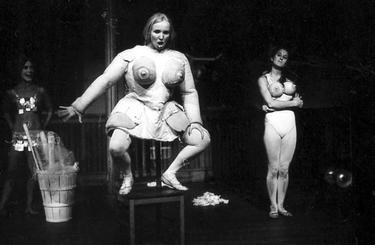
At the beginning of the show, the men brought out an actor called “Mannequin” dressed in a metallic-looking skimpy outfit. They manipulated her limbs, forced her to smile, and triumphantly declared, “This will sell.” The Mannequin, too, represented the strict roles “society allow[ed] women,” especially older women. According to Aili Paal Singer, who played Aili in all of the performances over the years, “the Mannequin spent most of the production inside a house-or closet-like structure” covered by a “gauzy fishnet.” Her sexualized costume was a two-piece “bikini-like dress made of squares of leather dyed silver to look like armor,” paired with a matching helmet and false hair, which depicted her as a “mechanized woman.”Aili explained, “She was basically exposed and ready to do anything that men wanted. She was the mannequin, moving and posing.”19
Meanwhile, Aili and Mary entered the shop wearing white tights and sleeveless leotards, giving their bodies a blank and almost-nude feeling. From the start, the women were overly apologetic, constantly dismissing their own needs in order to cater to the men and the Mannequin. When the men try to convince Mary to wear a specific dress they designed, Aili intervenes and “forces [Mary] to make a dreamlike descent” through her life, starting at birth and moving through girlhood, including experiences with sexuality and marriage, and even old age.20
During this physicalized journey, which relied heavily on movement, the audience saw Mary’s childhood impulse to do what she wanted and needed, and how those needs got squashed. In an important early scene, Mary’s needs were represented by blueberries. She wanted them, and grabbed at them. They messily got all over her. Mary’s mother slapped her daughter’s hands and ordered her child be a good girl, control herself and “keep it clean.” Mary learned the lesson to ignore her own needs. Whenever her hand automatically reached for the berries she wanted, she repeatedly hit her own hands, just as her mother taught her.
As Mary grew up, she learned more “feminine wiles,” carrying a straw hat and dangling purse, before eventually marrying the “Hunter,” who wore “hip boots,” a flowing shirt, and an “artillery belt.” The “Hunter” raped the sexually uneducated Mary, telling her, “You’ll learn to like it, like I do.” Later, stuck in their small, confining home, she became a housewife obsessed with house-cleaning, scolding herself with the old mantra from her childhood: “Keep it clean.” Mary eventually runs off with a new seductive male character, the “Wolf,” a man in a “funky fur vest and baggy pants dyed in pinks.” He represented her wants (like the blueberries). Yet soon he, too, dehumanized her, calling women “lovely creatures.” Later, he mistreated and abandoned her.21
After Mary’s story, Aili went into her own “descent” and confronted the many unsatisfying possibilities of married life. One path she explored was that of an independent woman, but trapped in a bad marriage. She was frustrated by her husband’s inability to share the responsibilities of the household. She became angry — a controlling “Big Mama” wearing a costume of a “pair of giant breasts.” Another of Aili’s scenes of married life trapped her in a “pseudo-liberated marriage,” where her husband’s career always superseded her own aspirations.22
Theater scholar Lynne Greeley, author of Fearless Femininity by Women in American Theatre (1910s-2010s), observed that How to Make a Woman offered “an unromantic treatment” of motherhood. In the play, mothers tended to be “repressive,” and pregnancy and childbirth were portrayed in comedic pantomime. Although Mary’s mother raised, educated, and cared for her, Mary constantly looked to her father for approval, repeatedly asking him, “Do you like me?” The same plea for validation extended to Mary’s adult relationships.23
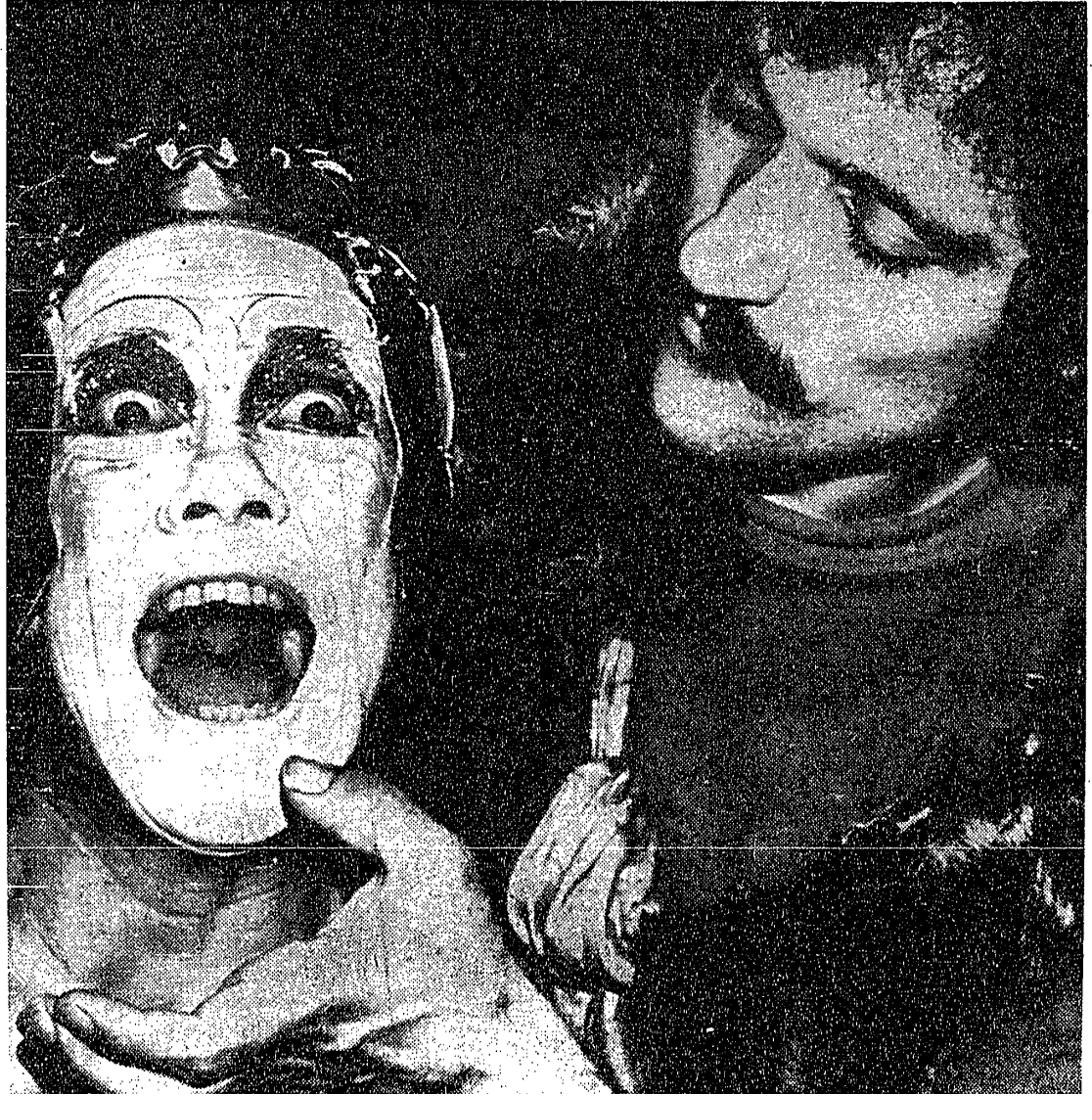
As the 90-minute play neared its conclusion, both women returned to the dress shop. Mary, who had by now accepted the stereotypical gender roles pushed on her, wore “plastic breasts” as her new dress. She then became the new shop Mannequin, while the old Mannequin was pushed aside as “useless.” Aili demanded a different dress from the salesmen, one that was not among the ones they were offering. When they insisted none existed, she “runs screaming from the shop into the audience, reaching for someone to leave with her.” This moment was often seen as “breathtaking.” (In later versions of the script, both women run out of the shop together.)
“[Aili] runs out of the shop, so [she rejects] the offerings that male establishment has put them in — being childlike, being the wife, being the sex object.” — Aili Paal Singer24
On stage
Additional Information
Script: For those interested in reading one version of the ever-evolving How to Make a Woman script, see this Script PDF.
Archive: To read more about Caravan Theater and Bobbi Ausubel, visit Harvard University’s archive webpage (https://guides.library.harvard.edu/schlesinger/performers-entertainers/theater) and search for Bobbi Ausubel’s name.
Film: To view the film of the play, contact Harvard University’s Archive directly.
1 Lynn Greeley, Fearless Femininity, 201-202; Bobbi Ausubel, Women in American Theatre, 287; and Kath Kenny, “Performing Consciousness Raising,” 180.
2 Kenny, “Performing,” 182.
3 Bobbi’s Caravan Narrative, 10.
4 Ausubel, Women in American Theatre; Bobbi’s Caravan Narrative; Kenny, “Performing.”
5 Ibid.
6 Ibid.; David Klein and Peter Kovner Oral History; and How to Make a Woman (HOW TO MAKE A WOMAN) script PDF.
7 Barbara Fleischmann MacKenzie-Wood Oral History.
8 David Klein and Peter Kovner Oral History.
9 Bobbi’s Caravan Narrative, 9.
10 Kenny, “Performing.”
11 Aili Oral History Interview; Kenny, “Performing.”
12 Barbara Oral History Interview; Laura Shapiro, “Theatre: End as a Woman,” Phoenix, October 13, 1970.
13 Aili Oral History Interview.
14 David and Peter Oral History Interview.
15 Ausubel, Woman in American Theatre; Bobbi Oral History Interview; Aili Oral History Interview; David and Peter Oral History Interview.
16 Aili, David, and Peter Oral History Interviews.
17 Bobbi’s Caravan Narrative; Script PDF; Kenny, “Performing,” 185.
18 Bobbi 1-1 Archive Files, 755; Greeley, Fearless Femininity, 203.
19 Kenny, “Performing,” 183; Script PDF.
20 Script PDF; Ausubel, Women in American Theatre, 288.
21 Script PDF; Greeley, 203.
22 Ausubel, Women in American Theatre, 288; and Kenny, “Performing,” 184.
23 Greeley, 203-204; Script PDF.
24 Greeley, 203-204.