
Co-founders & artistic directors
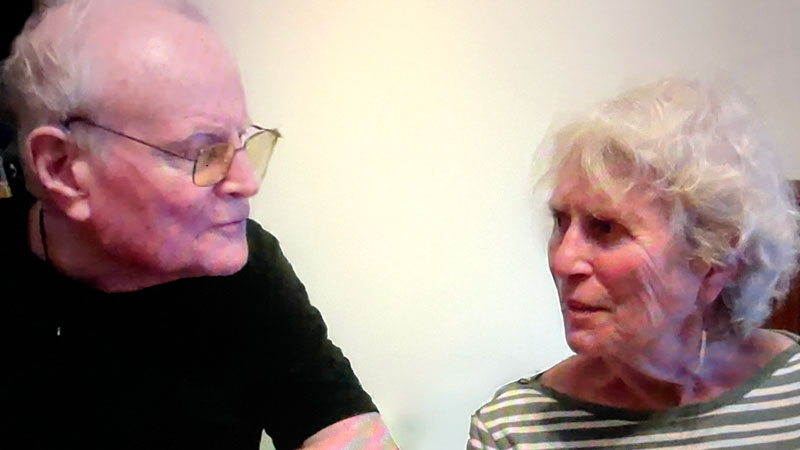
Stan Edelson
Born in 1929, at the start of the Great Depression, Stan grew up in and around New York City. His secular Jewish family struggled financially as his father tried to run a business selling surplus military camping equipment among other ventures.
Stan’s father believed women should stay home, hindering Stan’s mother’s aspirations to become a social worker, even when she had a college degree. Stan watched in frustration as she “stayed and stayed and stayed” in this marriage (though she ultimately left and later worked as a social worker thriving in this freedom). These early conflicts sparked his awareness about women’s struggles.
As a child, Stan was a natural-born artist who drew and painted as much as he could. At the age of 16, he left home to hitchhike and travel out West and to Mexico, taking odd jobs as he went, which heightened his awareness of the struggles of working-class people in the 1940s. Upon his return to New York City, he settled on the Lower East Side of Manhattan. At the Arts Students League in NYC, he studied alongside worldly classmates, including former GIs who had seen firsthand the ravages of World War II, further fueling Stan’s passion and dedication for social change.
By the early 1950s, back from more travels west, Stan began creating an extensive body of artwork — including woodcuts, lithographs, drawings, and paintings — which he then continued to expand on throughout his life. At that same time, he pursued a Fine Arts degree at Brooklyn College. There, he also led the square-dancing club — which is where he met Bobbi, his future wife. When Bobbi’s graduate studies brought them to Boston, Stan taught painting, drawing, and other visual arts at the Cambridge Center for Adult Education (CCAE) where he became a much-loved art and drama teacher for 58 years.
Although Stan’s creative interests began in the visual arts, he increasingly committed himself to theater, arguing that the “act” in “acting” is the root of both “activist” and “action.” He believed that the best art challenged power structures and promoted social progress. And he felt it was theater that offered him the most direct means of “putting forth good ideas.” Acting, he found, “liberates” people and fosters collective awareness. He also found it more satisfying to work directly with people vs. doing his art work in isolation.
To this end, in 1960-61, inspired by the civil rights movement, Stan formed the short-lived Social Action Theater, which produced one or two plays. For that, he and Bobbi went to local protests in Cambridge, MA, where people were demonstrating in support of the sit-ins happening in the American South, to ask participants if they wanted to join a play about the fight for racial justice and equality, which they then performed in African American churches around Boston. Also, again with Bobbi, he created the equally short-lived Forum Theater, which focused on raising awareness of the dangers of nuclear weapons.
From these early, transitory theatrical efforts, Stan learned the skills needed so that he and Bobbi could soon co-found and lead Caravan Theater. Stan’s years at Caravan, when he worked overtime as the theater’s Artistic Director, stage designer, playwright, theater director, and mentor to many, as well as parenting two young daughters, were the happiest of his life. (See here for the list of Caravan’s many productions.)
After Caravan Theater dissolved in 1979, Stan transitioned into clinical psychology. He earned an MA and worked with clients in his studio, in nursing homes, and youth centers. However, he never stopped directing plays and teaching performing arts at local arts centers and CCAE. He founded and ran Diversity Lab Theater, which valued a multicultural ensemble of actors and plays that, again, had a social and political message.
At the age of 87, when he was holding a retrospective exhibit of his artwork, a newspaper quoted him as saying, “From my birth in 1929 until now, I have been a learner, listener, and teacher. I am concerned: not only about myself, but also about the many other selves that make up this world…All my life I have done what I can to make all of our lives better — often through the arts.” (Citation: wickedlocal.com) Stan passed away in 2020 at the age of 90. He led drama and art workshops, coached actors, and wrote plays until the last year of his life, always committed and connected to the creative process.
For more about Stan Edelson:
Webpage with Caravan Theater members’ remembrances of Stan Edelson
Newspaper articles about Stan Edelson (2016): Cambridge Chronicle and Arlington Advocate
Event celebrating Stan Edelson (2017): vimeo.com/206507560
Stan Edelson Oral History (2012): Yiddish Book Center
In his colleagues’ words
Those who worked with him remember a rare combination of artist and activist. Barbara Fleischmann MacKenzie-Wood recalled his boundless curiosity — a drive to “explore people” and understand “what made people and society different” — and how he built trust by listening intently and guiding actors with questions rather than commands. She called him “a painter, a writer, a director,” and ultimately “a creator.”
“[Stan] was nourishing. He nourished my thoughts, my abilities… a grower. A grower of thoughts, a grower of yourself.” — AILI PAAL SINGER
Under his direction, Aili said, “we became his colors and his palette.” Peter Kovner remembered his intimacy as a director and called him a “centrifugal force” whose energy touched everyone in his orbit, his leadership like his drawings: “bold strokes.” David Klein was struck by Stan’s “certain sureness in who he was and what he felt.” And once, when a daughter spilled milk at dinner, Stan simply cleaned it up and poured another glass — “not a word… just fix the problem. I thought, this is the kind of parent I want to be.”
“Stan taught me to take risks. I am enormously grateful for that.” — BOBBI AUSUBEL
Aili tied his drive to his Jewish background; Peter, who hadn’t noticed it then, now sees how much the idea of repairing the world shaped the theater: “My God. We were steeped in it.”
More on Stan: oral history (2012) · a 2017 celebration · honored for six decades.
He nourished my thoughts, my abilities… a grower of thoughts, a grower of yourself.Aili Paal Singer, on Stan Edelson
Bobbi Ausubel
In 1963, Bobbi Ausubel, 28, and her husband Stan Edelson, 34, stepped into a world unknown to them: theater. They hoped to use theater as an activist vehicle for social and political change. They began their theater work by going to picket lines in support of the Civil Rights Movement integration sit-ins in the South, and calling out to the protesters, “Who wants to act in a play about sit-ins?” With the resulting excited volunteers, their theater life began. (To read a detailed history of Caravan Theater, see here.)
Bobbi, born in 1936, grew up in a Jewish family in the 1940’s and 1950’s in Borough Park, Brooklyn, New York. Her childhood neighborhood was filled with immigrant families. In fact, Bobbi’s early introduction to activism was from them; she spent her girlhood playing ball and jacks in the streets with her friends, where she would hear talk about how their families had fled oppressive rules in Russia and across Europe, and yet still felt connected to Europe’s left-leaning political movements. However, in Bobbi’s own home, her parents were not political.
In 1914, Bobbi’s father, Beresh “Benny” Ausubel, fled his home at age 14. His mother sent him away from his small town of Rozwadów, Poland, to escape conscription into the Polish army. For years he struggled alone, hiding all over Europe (Austria, Germany, Denmark and England), while World War 1 was raging around him. Finally, traumatized from his experiences, he made his way by boat to Argentina and then the U.S.
Bobbi’s mother, Ethel Kartiganer, was born in the U.S., after her poor family had emigrated from the Polish countryside. Ethel was the only child in her family born in the U.S. Ethel endured trauma as a child, which may have contributed to her mental illness. As a child and teen, Bobbi was not aware that her mother’s severe limitations were due to schizophrenia, electric shock therapy and the strong medications that Ethel was given to suppress her psychosis.
Around 1935, Bobbi’s parents met in Manhattan’s Lower East Side. Bucking the trend, Beresh kindly spent decades of his married life caring for his wife at home, instead of institutionalizing her in a mental hospital.
The rare activism Bobbi witnessed in her family when she was growing up was when her father occasionally went to the local Democratic Club to plead for their help in getting his landlord to give their always-cold, top-floor apartment more heat. Meanwhile, Bobbi was quietly forming her own questions as she witnessed how hard her father, a factory worker, worked for such little money.
As a young girl, Bobbi realized she did not want to follow her mother’s path, or the path she assumed all married women fell into: stuck in the home, living an unfulfilled life. Additionally, she didn’t want to wear lipstick or put curlers in her hair like the other girls in her class. Bobbi fought with her mother, who feared her daughter would never find a man to support her. Bobbi could not imagine a life limited to sitting in an office, bookkeeping, which was the future her parents hoped for her. She was eager for something different. She insisted on going to college.
In her youth, Bobbi delved into history books, which raised her awareness of oppression. She was deeply moved by stories of Jewish communities being expelled from a country, only to be invited back and then persecuted again, century after century.
But Bobbi’s real political awakening took place in her teen years, from ages 15-18, starting in 1951. It began at Hashomer Hatzair, a Jewish, progressive-socialist youth organization based on the values of equity, community and social responsibility. Attending the summer program in Liberty, New York, greatly changed Bobbi’s outlook on life. When she arrived at the upstate New York camp, much to her surprise the group spoke about women’s equality and the heroic women tractor drivers at the Israeli kibbutzim. Together, the youth group read Ibsen’s A Doll’s House, about a woman needing to leave her husband and family in order to know herself. All of this excited Bobbi; she felt she had found a home where women were considered equal.
Bobbi’s early experience in a progressive youth movement helped her to later become one of the early leaders of the Second Wave of the Women’s Movement in the U.S., in the 1960s and 1970s. The political learnings she received in her youth led her to a lifetime of activism for social change.
At age 18, Bobbi became outraged at the substandard living conditions she saw in parts of New York City. So she joined pacifist teams that were repairing and painting people’s homes in Harlem, and later helped to organize rent strikes there. Repeatedly, she was trying to figure out how best to bring about positive change in the world. She did this by asking, “What would have made my parent’s lives better?”
Around that same time, Bobbi enrolled in Brooklyn College, against her mother’s wishes. Tuition was $6 a year. She set out to study biology, a path that promised her better financial stability than her parents had known. At college, Bobbi met Stan, her future husband, at a folk-dance club popular with left-leaning students. An artist and avid anti-McCarthy spokesperson, Stan too had questions about how to make a more equitable society. Bobbi greatly appreciates that Stan modeled to her how to be a risk-taker.
Even while asking questions about how to be an agent of social change, Bobbi knew the importance of earning a living, which was emphasized during her childhood. So after getting an undergraduate degree in Biology, she and Stan moved to Bar Harbor, Maine, where Bobbi had secured a job at Jackson Lab. Soon after, she applied to three graduate schools and was accepted by all. She chose Harvard — because it was on the East Coast and easiest to get to in their old, beat-up car. She had never heard of “Ivy League” schools and innocently went to graduate school on a full scholarship, without grasping how significant it was to attend such an elite institution.
At Harvard, Bobbi studied with multiple Nobel Prize winners, including James Watson and Francis Crick, the discoverers of DNA’s double-helix structure, as well as E.O. Wilson, known as the world’s foremost expert on ants. Yet she was not happy spending her time looking through a microscope. When she became pregnant with her first daughter, Naomi, Bobbi decided to leave biology behind. She says she felt embarrassed and guilty, and as well as pleased to exit. Yet she was grappling with the loss of her scientist identity and the unsettling prospect of becoming “just a housewife.” This conundrum left her feeling deeply conflicted and lost.
Two years later, now with another beautiful baby girl, Bobbi and Stan explored a new passion, theater, thanks to their friend Josie Simon, who told them about anti-apartheid theater in South Africa. Returning to their activist roots, Bobbi and Stan wondered, “Could theater be a way we could influence people to stand up for humanity?” While not abandoning his visual art, Stan also realized the performing arts was a more social and interactive form of art that strongly appealed to him. (link to Stan bio)
This was when they co-founded Caravan Theater. (For more details on the history of Caravan, see the webpage About Caravan Theater.) They were excited to use theater in this political manner, but soon discovered that theater could be a creatively rich art form.
Once Caravan got going, Bobbi wanted to learn more about theater. She went to Boston University to earn a Master’s degree in Theater Directing. (However, Bobbi says that most of what she learned as a theater director came later, from her work with the many actors at Caravan Theater, and from her subsequent years of teaching acting.)
Gender equality had been an important idea for Bobbi since her childhood. It was this that led her to propose to her theater troupe, still in its early years, that they create a play about women’s lives. This was an original and groundbreaking idea in 1967. After heated deliberations, the troupe supported Bobbi’s proposal.
Subsequent improvisation sessions went on for months with the volunteer Caravan actors, with Bobbi as the director, focused on the societal conditioning of girls and women. Stan attended all of the sessions, and they informed him as he wrote the play How to Make a Woman. (For more on the history and impact of this play, see About How to Make a Woman. This play, with Bobbi as the theatrical director, led to Caravan securing a leading role in the rising Female Liberation Movement, as it was then called. The play ran on and off for five years, consistently bringing in audiences.
In 1974, after Caravan’s production of How to Make a Woman saw significant success, Bobbi won a grant from the Radcliffe Institute (now called Radcliffe Institute for Advanced Study at Harvard University). There, for two quiet years, Bobbi wrote her play Focus on Me. The play was about a filmmaker’s struggle to create her films. Bobbi describes the play as her personal journey toward accepting her femininity instead of regarding femininity as a weakness.
Later, Bobbi collaborated with award-winning author Tillie Olsen, and adapted several of Olsen’s stories for the stage. One, the adaptation of Olsen’s novella Tell Me a Riddle, won ‘One of the Ten Best Plays of the Year’ by the Boston Globe, New England’s leading newspaper. Bobbi says she chooses topics for her plays based on her deep feminist searchings — both an outward search for remaking society and an inward search for emotional self-awareness.
Also in 1974, Caravan’s women teamed up with feminist playwright Martha Boesing’s long-running feminist theater company, At The Foot of the Mountain. That collaboration introduced Bobbi to a theater technique called Emotion Warm-Ups.
Bobbi’s marriage with Stan ended in 1974 and they remained lifelong friends. At this point, she decided to leave Caravan Theater.
Over the following decades, Bobbi went on to direct many other productions, including but not limited to: Antigone Too: Rites of Love and Defiance, by Martha Boesing; Silkwood, by Jehane Dylan, produced with Union Sister Theater, in Washington D.C., which labor unions toured to 200 U.S. cities; and Bobbi’s own play Fossils & Relics, which featured scenes of contemporary family life. This play toured New England, with the backing of the Massachusetts Cultural Council.
Meanwhile, Bobbi taught theater at the University of Massachusetts, Boston, for two years. She then taught acting at the Boston Conservatory of Music, Dance and Theater, also in Boston, for 20 years. There, she says she discovered how teaching was a rich arena for learning more about acting. During her time as Chair of the Theater Division, she added physical-based acting for the first time to the undergraduate curriculum.
For many years, Bobbi worked hard, using theater techniques as well as psychotherapy, to understand and heal/recover from her own traumatic childhood experiences. As part of this depthful process, in the 1980s she created Up From Silence, a drama group with the mission “to explore how we got hurt, and how we healed” from child abuse. Bobbi also became a Registered Drama Therapist during this period.
In 2002, Bobbi, with her daughter Rivka Solomon, invented a women’s and girls’ empowerment project called Leading a Bold Life, based on the book That Takes Ovaries: Bold Females and Their Brazen acts, edited by Rivka Solomon. They also wrote a play, Bold Women, Brazen Acts, adapted from the book. The play saw dozens of productions around the globe, and it was often used as a fundraiser for women’s causes. Excerpts of the book and play were dramatically read by local community women at about 1000 empowerment events. Bobbi herself led dozens of these empowerment events across the U.S. and around the globe.
‘Feminism is global’ became a later call from the U.S. women’s movements. At 70 years old, inspired and seeking new experiences, Bobbi traveled to India. There, sponsored by the India-based NGO Apne Aap Women Worldwide, she continued conducting (acting-based) empowerment programs, this time for sex-trafficked and prostituted women and girls. Bobbi did this work in rural villages and in urban red-light districts. For ten years, off and on, she collaborated with both rural and urban centers dedicated to combating sex trafficking in India, Nepal, Bangladesh and Guyana. During this time, Bobbi and daughter Rivka Solomon created a manual for how to lead girls’ empowerment workshops. Years later, Bobbi wrote It Happened in Khatija’s Village, a play about breaking the cycle of intergenerational prostitution, which was performed in Kolkata, India.
Currently, Bobbi devotes her time and energy to advocating for the chronic illness Myalgic Encephalomyelitis (ME). In 2023, she co-created Pillow Writers, an online/virtual writing group for homebound/bedridden people living with ME and Long COVID. That international literary group has expanded into five ongoing groups. (More information about Pillow Writers is found here: www.pillowwriters.com.) The group has put out two anthologies. Now at almost 90, Bobbi enjoys teaching acting and improvisation abroad as well as in her senior community through Acting our Lives productions (a performance memoir of community members), where she lives with her partner Cecelia Wambach. Happily she admires her two brilliant activist-feminist daughters.
Bobbi Ausubel’s papers are archived at Harvard University’s Radcliffe Institute Schlesinger Library. Some can be seen online: https://guides.library.harvard.edu/schlesinger/performers-entertainers/theater
Actors & directors
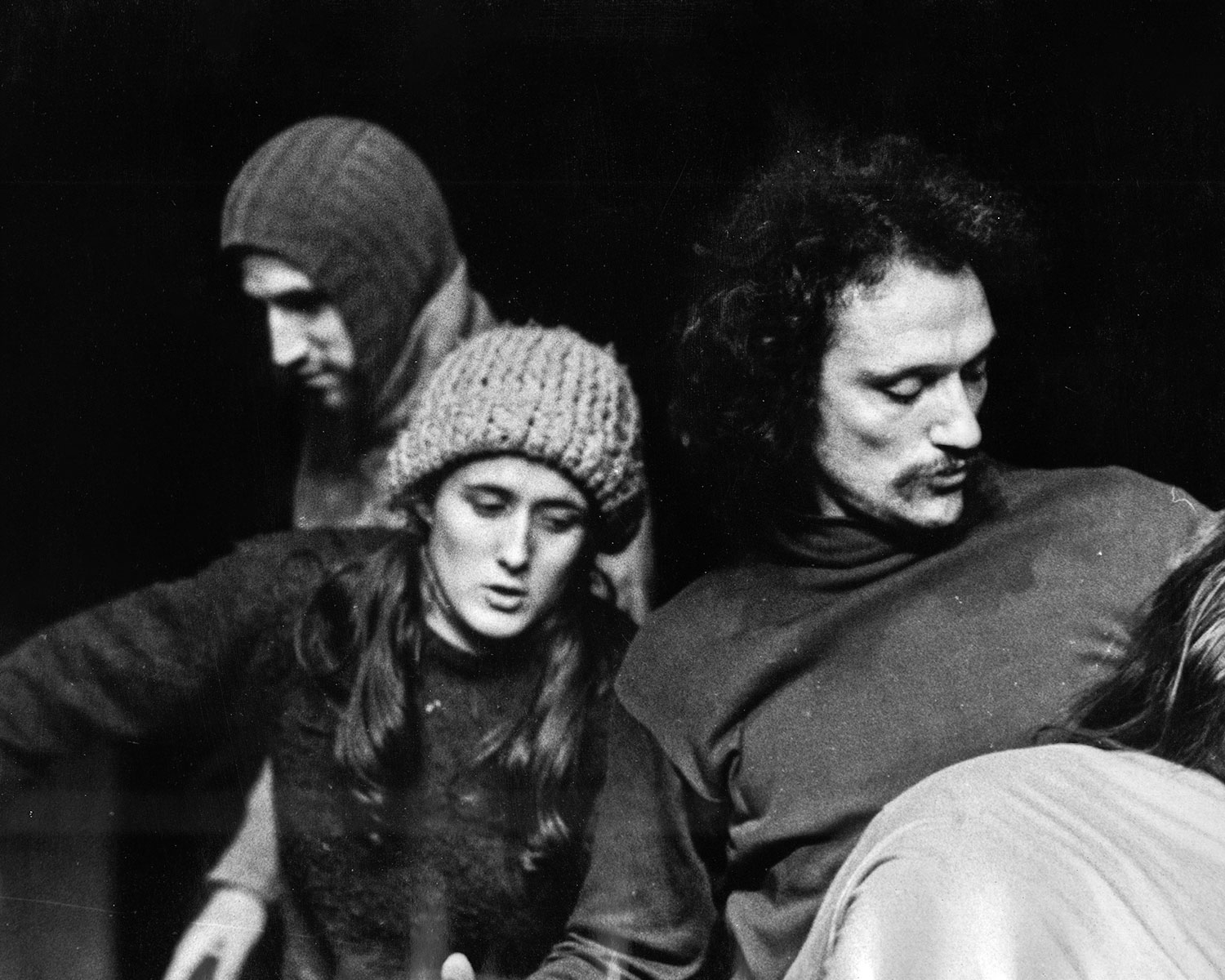
Aili Paal Singer
Amid the upheaval of World War II, Aili and her family fled Estonia for Germany, moving through various displaced persons camps before finally boarding the General Hahn, a military transport ship, and arriving in the United States on April 19, 1949.
Settled in New York City, Aili spent much of her time at the Estonian House on 34th Street and Second Avenue in Manhattan, a private club founded in the 1920s. To preserve cultural ties, members had to speak Estonian in order to enter. Following her mother’s wishes, Aili was deeply immersed in Estonian culture from an early age — she joined the Estonian Girl Guides, sang in the choir, attended dance classes, and participated in social events at the Estonian House nearly every weekend.
Both of Aili’s parents had lost their parents at a young age. Her mother, orphaned at 14 during the 1918 pandemic, was gentle, patient, and supportive, always encouraging Aili to follow her own path. Her father, orphaned at six, grew up with two older brothers and worked tirelessly to support his family. He covered all of Aili’s education costs himself, refusing scholarships and insisted that she not rely on external help. Politically, he believed communism was dangerous — an opinion shared by the family’s history under Soviet threat.
Early on, Aili discovered her love of dance. Teachers and classmates nicknamed her “twinkle toes,” although she believes her acting, more than her dancing technique, caught people’s attention. Despite her father’s dream that she become a chemist, Aili could not resist the arts. She auditioned for a performing arts high school in Manhattan and was accepted into the drama department, which allowed her to continue studying dance and movement.
When it was time for college, Aili fell in love with both Boston University and the city itself, relishing in the freedom to think critically about the world. For the first time, she could openly question and discuss politics and global events — subjects rarely discussed at her strictly Republican home. At Boston University, she began to see herself beyond the Estonian community, saying, “I decided to open my mind and became aware of a lot more.” She and her husband were actively anti-war and opposed the Vietnam war, but she had friends and relatives serving in Vietnam. Out of respect for them, she chose not to march in protests, explaining, “I felt it was unfair to them, so I didn’t do that.”
During this period, Aili also found Caravan Theater by answering an advertisement for actors. Caravan soon became a central part of her life, both personally and professionally. Her husband often attended the men’s discussion groups after performances of How to Make A Woman, which widened his feminist ideals and strengthened their relationship at home. strengthening his feminist ideals and solidifying their relationship at home. Their daughter, Maya, spent her earliest months backstage at Caravan, being breastfeed during and between performances.
“Caravan was food for thought in lots of different ways,” Aili recalls. “It made me grow as an actress. We experimented with how to use our body, how to use our voice… It was a discovery. A discovery of relationships. A discovery over the world, and a discovery of how I can contribute.”
Barbara MacKenzie-Wood
BARBARA MACKENZIE-WOOD, actor, director, and University Professor holds the Raymond W. Smith endowed chair at Carnegie Mellon University School of Drama where she taught acting in their conservatory acting training program for thirty-seven years, including serving Head of Acting/Music Theatre for ten years. She received the Henry Hornbostel Award for teaching excellence in the College of Fine Arts.
Barbara is featured in: Shakespeare and Stanislavsky a Practical Guide for Actors, Directors, Students and Teachers
Acting Teachers of America: A vital tradition, where she is listed as one of the fifty most influential acting teachers in the United States. She continues to act, teach and direct professionally.
CARAVAN THEATRE:
Caravan Theatre was my first professional theatre job. It was in the summer of my Junior year at Boston University where I was an acting major. I saw an ad on the bulletin board of the theatre department. It read, Caravan Theater, a theater company in Cambridge Massachusetts is interviewing actors to become members of their summer company. They were producing Bertolt Brecht’s Mother Courage. Bobbi Ausubel, a Masters Directing Major, would be directing the production.
I had previously seen Bobbi’s directing work in her astounding production of Samuel Becketts’ Waiting for Godot at Boston University, so I jumped at the chance to audition for her.
The audition/interview was at their flat in Cambridge. When I arrived at their flat Bobbi’s husband Stan was there with their two very young children running happily around. There was art everywhere on the walls. It felt ‘messy wonderful’ and like nothing this midwestern girl- me- had ever seen. I believe we just talked and, in the end, I was invited to spend the summer with Carvan Theatre at Sacred Heart College working on Mother Courage which we toured in the Boston area. One of the places we performed was in the living room of John Kerry’s parents.
It was a wonderful creative summer. Completely stress free. This is unique for theater making.
The next time I worked at Caravan was in 1970. I was a member of Caravan Theater for five seasons. I worked under my married name Barbara Wood (Fleischmann).
Caravan theatre was a life changing experience for me. There was a spirit of true collaboration.
It was supportive and loving. In my now sixty plus years of working professionally I have never encountered such a supportive environment. I cherish my memories of Caravan Theatre.
We performed our production of How to Make a Woman off and on for five years at the Harvard Epworth Methodist Church. I believe this piece of theater, with its accompanying, inspiring and sometimes argumentative audience ‘talkbacks’ following every performance helped to spearhead the Second Women’s Movement in the United States.
We toured How to Make a Woman throughout New England and performed by special invitation at the International Festival of Festivals in Wroclaw Poland. This was years before the fall of the Berlin wall. There were tanks on the streets as we passed through East Berlin. Our passports were constantly being checked.
Our rooms were ‘bugged’ at the festival. If we wanted to talk freely with other members of the festival we had to go to the corn fields for a barbeque. It was one of the most inspiring and exhilarating times of my life.
Other productions at Caravan which I performed in: Mother Courage and Her Children, by Bertolt Brecht, directed by Bobbi Ausubel, Jason and Medea written by Stan Edelson and directed by Bobbi Ausubel, Waiting for Godot by Samual Beckett directed by Bobbi Ausubel, Come Closer You’re Smothering me written and directed by Stan Edelson.
I continue to be inspired by the work of Bobbi and Stan, and I am very grateful to have spent so much of the early part of my professional life as an actor under their mentorship.
Over the course of my career, I have acted for such major directors as Lloyd Richards, Paul Sills, Jacques Levy, Joanne Akalitis, and Jacques Lecoq. I was a member of the acting company of the Long Wharf Theatre under Arvin Brown and Edgar Rosenblum for five seasons.
As a professional actress I have appeared in numerous roles in New York, regional theatre, stock and film.
I am an actor, director, teacher and board member for the Irondale Ensemble Project, a forty-four-year-old Obie Award winning theatre company in New York City of which I am a founding member. I have toured with Irondale to Russia, Germany, South Africa and India.
While in South Africa, with Jim Niesen, we created the theatre program for Global Camps South Africa, a pioneering international organization created to fight the devastating effects of HIV/AIDS on children in that country.
As a passionate advocate of international exchange I founded the International Study Abroad Experience for Senior Acting/Music Theatre students at Carnegie Mellon in which selected students spend a semester were imbedded into classes and productions at some of the world’s leading theatre training programs including the Royal Welsh Conservatory (Cardiff), LAMDA (London) Drama Center (London) Earnst Busch (Berlin) Royal Scottish Conservatory of Music and Drama (Glascow) Meta Festival (Florence Italy) NIDA in Sidney Australia, National Acting Training Program (Cape Town South Africa). In the winter 2025 I was invited to teach acting at the IFTS (International Festival of Theatre Schools) at the University of Calicut, Thuzar India.
Internationally, I have taught and directed at the Moscow Art Theatre/Carnegie Mellon University Graduate Acting Program Moscow, the Drama Center London, the Royal Welsh Conservatory of Music and Drama Cardiff, and at the META Festival in Florance Italy.
Favorite Roles: Mary: How to Make a Women, Caravan Theatre.
David Klein
David in his Caravan Years (1969-73)
Born in March 1945, David grew up in Manhattan’s Upper West Side — an area then considered West Harlem, now called Hamilton Heights. He recalled his neighborhood as racially diverse, with Black, Puerto Rican, and white families living side by side. Initially attending the local public school, David transferred to an intellectually gifted program in a predominately Jewish district in the fourth grade. Even though his mother’s side was classic “WASP” — tracing lineage back to the Mayflower and 17th-century Dutch settlers — David found himself strongly identifying with his father’s Jewish culture and heritage. Both of his parents profoundly influenced his worldview. His mother’s strong work ethic showed him the possibilities for women to excel beyond the domestic sphere and primed his early feminist ideals. His father believed in teaching David self-reliance, teaching him to sew while reminding him, “You’re not going to have your mother around all the time to do this for you, so you should do it yourself.”
Both of his parents were Communists, although he did not learn that until he was around fifteen years old. They had kept it quiet, worried about FBI scrutiny. When David finally discovered their Party membership, he was shocked. “Of course,” his mother said. “We just never told you because we thought it was safer for you not to know.” Despite their political leanings, David’s parents never pressured him to adopt their views.
Nevertheless, from a young age, David immersed himself in radical circles. He spent summers at Camp Kinderland, a program founded by Jewish labor activists, and took classes at the Student Committee on Progressive Education, in Union Square, the youth division of the New York School for Marxist Studies. By his teen years, David was on the board of the student committee and wholeheartedly involved in progressive causes. During his sophomore year in high school, he protested against the “duck and cover” nuclear drills — insisting that Americans should work to prevent nuclear war rather than pretend they could survive it under a school desk.
After high school, David enrolled at Columbia University, where the world seemed far more complex than the simple “worker versus bosses” framework he had once embraced. By seventeen, he quit the radical groups that had once defined him, yet his devotion to social justice remained strong. David joined civil rights demonstrations, picketed Woolworths during sit-ins, and helped organize anti-war marches down Fifth Avenue. Due to his love of folk music, he was assigned to contact singers to perform at rallies. Later, in graduate school at Berkeley during the Vietnam War, David took part in efforts to shut down the draft board in Oakland, narrowly avoiding arrest.
Unsurprisingly, David’s passion for the arts also ran deep. In the early 1960s, he studied at HB Studio in New York with the illustrious Uta Hagen. He also had the good fortune to study with Anne Shepherd, who had studied the physical theater techniques of Jerzy Grotowski and had worked with him during a residency at NYU. This exposure to experimental theater and his longstanding commitment to social justice led him to explore more innovative and political theater projects in New York and Boston, ultimately leading him to answer an ad for Caravan Theater in BackStage.
David was hired in the spring of 1969, then spent the summer doing high-class summer stock (Genet, Albee, Williams, Lewis Carroll) with EarthLight Theater, founded by Allan Mann, an actor he had known at Columbia. EarthLight wound up performing in the campgrounds at the Woodstock Festival, another early highlight of his career. EarthLight went on to LA to seek fame and fortune, but David went to Caravan instead, to do political theater.
He was a member of the Caravan company from 1969-73, performing in How To Make a Woman; Caucasian Chalk Circle; Hands Off!; Waiting for Godot; The Jewish Wife; and Come Closer, You’re Smothering Me; and directing The Exception and the Rule. In 1973, he was part of the group that left to form The Cambridge Ensemble.
He performed with the Ensemble for 2 years and then free-lanced in the Boston area until 1977. A personal highlight from that period was a production of Franz Kroetz’s play, StallerHof (“Staller’s Farm”), with Reality Theater in Boston that they performed at an international festival of avant-garde theaters in Baltimore in 1977.
Meanwhile, he had met and fallen in love with Virginia Rankin. We met at a post-HTMW discussion, of course. We each led separate gender-based groups, after which she used to drive him home. In the fall of 1970, we moved into a commune together, with her 2 children from her recent marriage. Since the fall of 1971, we have lived together, though the kids grew up and moved out long ago. We have 3 grandsons in their 20’s and now a great-grandson (!).
In 1977, Virginia got a job as a teacher-librarian at a middle school in Vermont where she would be making the astonishing sum of $10,000 a year – big money for us at the time. We lived in Vermont for 8 years, during which time David ran a small theater in a nearby town (https://www.parishplayers.org/), eventually supplementing his earnings there with a job at an electronics company, where he became a Fortran programmer. He also ran a small touring company doing shows for kids, mainly elementary and middle school, where he could continue to be an active feminist. For instance, all the heroic warrior roles were played by the women in the group, and, in a production of Jack and the Beanstalk, David got to play both Jack’s mother and the Giant’s wife.
In 1985, both our kids were either graduating from college (Alair) or starting college (Brendan) so we parents decided we could move, and since Virginia had determined the 1977 move, it was David’s turn. Looking for a place where he could do more theater – but one that was not a big city, like Chicago or New York – he proposed either Minneapolis or Seattle. Virginia said, “No more cold places,” so they moved to Seattle.
Which turned out to be an excellent move. Brendan followed us there in 1990, after graduating from college, shortly thereafter getting a job at Microsoft and moving on from there to various entrepreneurial tech companies, now part of a lab doing cancer research (https://www.maccosslab.org/skyline-team). Alair moved to Portland, Oregon, in 2006 to be a professor at the Vancouver campus of Washington State University (https://soc.wsu.edu/people/archive-faculty/maclean-alair/) after getting her PhD in Sociology, so we are all pretty close to each other. Which meant we could see a lot of our grandkids while they were growing up, which Virginia and David both thoroughly enjoyed. Of Brendan’s 2, the oldest, Alex, works at the tech company Nvidia, got married a year ago and just became a parent. The youngest is still in college and also very tech-oriented. Alair’s son, Dylan, was an outstanding baseball pitcher in Little League and later in high school, was drafted out of high school by the Texas Rangers, and is now pitching in their farm system (https://www.milb.com/player/dylan-maclean-694395).
Virginia taught middle school in the Bellevue school district, became a storyteller, published numerous articles in Library journals and wrote a book in 1998 on teaching research to middle schoolers, that was still selling 27 years later! https://www.amazon.com/Thoughtful-Researcher-Teaching-Research-Information/dp/1563086980
Theater in Seattle has also been very good for David, although generally much more mainstream than he had been used to. He joined the union (Actors Equity) in 1986 and did at least 1 union show every year for 25 years, so now he has a modest pension. Highlights include some major roles, for smaller theaters – best known are Willy Loman, Capulet and Shylock – and a lot of major roles in less well-known plays, also for smaller theaters – Ezra Pound, Alfred Stieglitz, Solomon in Arthur Miller’s play, The Price, Dr. Kheal (Marie Irene Fornes), Jack in Neil Simon’s plays Brighton Beach Memoirs and Broadway Bound, Irvin in August Wilson’s play Ma Rainey’s Black Bottom. Also 5 summers of Shakespeare in the Park with a local group called GreenStage (https://greenstage.org/). Over 150 roles in 40 years, including staged readings.
He has helped found 3 theaters – Book-It Repertory Theater (https://book-it.org/), doing adaptations of novels and short stories in a non-naturalistic way that Caravan people would recognize, by including narration done in character; Playworks (https://playworks.weebly.com/), doing literary stuff and supported by the state Humanities Commission; and Tales of the Alchemysts, also literary, but focused on Jewish literature (Singer, Malamud, etc). Only the Alchemysts are still around (https://alchemysts.org/) though Book-It is sort of coming back.
Now at 80, opportunities have become somewhat scarce and his theatrical future is uncertain. Sic transit gloria.
Joe Volpe
Raised in Pennsylvania by a mother who valued education above all else, Joe grew up hearing that he and his siblings would go to college — no exceptions. His mother’s passion for politics and deep involvement in the local community fueled her vision for their future. Her determination and bold spirit remain among his greatest influences.
Joe also formed a close bond with his Polish grandmother, a devoted gardener who spoke only Polish. Even though he knew only English and Italian, they connected and communicated through shared tasks and gestures. He remembers sketching her garden and labeling each flower, as well as spending afternoons on her old swing. These simple yet meaningful experiences sparked Joe’s lifelong love of design and nature, ultimately guiding him toward a career in landscape architecture.
However, his first introduction to theater came through dance — particularly the polka, which he remembers watching his father perform. At the urging of his friends and company members, John Furlong and Mike Appleby, Joe joined Caravan despite having no prior stage experience. Caravan’s blend of political storytelling captivated him, and he eagerly threw himself into set and prop design — hands-on work that felt natural to him. But it was through movement that Joe truly distinguished himself. His dance background became invaluable to the director Bobbi, who sought to create theater that relied on movement as well as dialogue. Joe’s gift for physicalizing ideas helped bring her vision of “movement theater” to life.
While completing his master’s degree at Harvard in the early 1960s, Joe felt invigorated by the anti-war protests that coursed through Cambridge. He was heartened to see people fired up and mobilizing against global injustices: an energy Caravan employed in their performances. To Joe, their daring, sometimes shocking production never felt out of place; blending art and advocacy felt entirely natural. “With Caravan, he says, “it always felt right.”
Joe later left Caravan theater to accept a teaching position in Landscape Architecture Design at University of Massachusetts Amherst, where he taught for over 20 years. His professional work includes both public and private practice in South America, New Zealand, France, and North America on projects ranging from large-scale design to gardens. Joe explores the dynamics of landscape architecture as an art form and as a political and community process. He and his wife, Pauline Volpe, have two sons.
Lynn Bratley
CARAVAN THEATER
I moved to Boston in 1966 and soon met Bobbi Ausubel. When she learned I had studied children’s drama, she invited me to perform and make the puppets for a children’s play she was writing, “How Nanabozho Brought Fire To His People”. Joe Volpe played Nanabozho, John Furlong was the fabulous Thunderbird, and I played the puppet Squirrels and The River.
Later I worked with Ingrid Furlong and Pauline Volpe on a street theater play, “Myths and Tales of the Maoris”, with an ensemble of actors, including Peter Kovner, along with a cast of puppets created by Eric Levinson.
A few years later, Bobbi cast me in “The Millie Cartoon” with Peter Kovner. This play was a sequel to “How to Make A Woman.” Both plays addressed the unspoken double standard between men and women and dramatized the injustice that was going on behind the façade of happy relationships.
I taught children’s drama and puppetry under the auspices of the company and made props for productions. I observed how Bobbi and Stan directed the plays, and how they created and honed scripts with input from the actors and the audience. Post play discussions with the audience were a crucial element of each performance.
IMPROBABLE PLAYERS
I started my own non-profit theater company in 1982 – the year I got into recovery – to teach people about addiction/recovery. I hired young actors who were also clean/sober, and we developed plays from our own real stories. The Improbable Players caught on in popularity because the plays and discussions addressed current issues and got people talking and asking for help.
Theater is a powerful way to reach people about the burning issues faced by society. Caravan Theater dramatized the unspoken inequality of male-female relationships and helped to start a dialogue to help men and women look more closely at their roles. Improbable Players brought the discussion about alcohol/drugs/recovery out of the closet, dispelled stigma, and modeled ways of asking for help.
In the 35 years I directed the company, I hired, trained and mentored over 200 young professional actors, all in long-term recovery, as creative partners in the development and presentation of the performances and workshops. And in collaboration with these actors, I developed, wrote and directed ten different applied theater performances about issues caused by the harmful use of alcohol and other drugs, and their prevention.
My real story of hiding my drinking, unknowingly hurting my family, and finally learning how to stop with help from others, became a simple, classic play that helped hundreds of thousands of people, from students in their schools to professionals at conferences.
EDUCATION
WASHINGTON PARK HIGH SCHOOL, Racine, WI, Diploma, 1960 — Park High Hall of Fame 2011
UNIVERSITY OF WASHINGTON, Seattle, WA, Bachelor of Arts, Creative Drama and English,1965.
TUFTS UNIVERSITY, Medford, MA, Masters in Theater Education, 1986 — Outstanding Career Achievement 2003
Peter Kovner
A) What led me to join Caravan Theater –
I did not join Caravan because it was a feminist theater. To say that would be rewriting the past to suit the present. And it seems even Caravan did not yet to think of itself in those terms. The Vietnam War & civil rights hung over everything during the early Caravan years and dominated most political and social discussions. In theater, women were frequently in charge and so that didn’t seem unique. I wanted to create and perform theatrical events which had meaning, quality & impact; get out of NYC to a more rural, less hurried environment; and be with my wife and closest friends, who happened to be in Boston at the time.
But let me back up five years to college where I first went on stage.
I was never a “theater kid,” though I was intermittently pulled in that direction in school, only to be embarrassed by and then back away from the artistic & emotional commitment it took to successfully inhabit a role and the imagined world surrounding it. My role-play was on the field of sports where I would imitate my Brooklyn Dodger heroes like Duke Snider or Don Newcombe. Normal kid stuff, which, to my athletic detriment, met reality as I got older and the competition got serious. My baseball coaches observed that I sometimes seemed to be in a fog on the ballfield. Indeed, I was fantasizing rather than being present. The great English actor Sir Ralph Richardson described acting as “dreaming awake,” which in my dotage I think describes human existence itself.
In college, though never a theater major, I was pulled on stage by friends to do a lead in a student’s one-act class assignment. It was a very small school that needed everyone to participate in everything. Had I gone to a larger or professional school like BU, NYU or Carnegie, I never would have been asked, much less thrust on stage. Though I found that first play corny and unrealistic, it lit a tiny flame in me which grew stronger when we performed a student adaptation of Joseph Heller’s Catch-22 years before the movie debuted. Even in retrospect, ours was a far superior rendition of the book’s gut-wrenching humor, horror, tone and message. Likely because we were all soon heading to the meatgrinder of Vietnam and had classmates already “in country.” The next spring of senior year, I took my first-ever class in theater. Unlike most all my other subjects – where I studied just enough to get by – I was surprised to find myself doing far more then asked or required, and so, spurred on by a brief compliment from a classmate whom I barely knew but admired as serious and thoughtful (and pretty), with Vietnam looming, and no other marketable talents, I thought to pursue acting, abandoning my beloved new life in Vermont… and, as Ishmael had it, “…to sail about a little and see the theatrical part of the world.”
A friend at Columbia University film school called to say he was looking for a roommate. Thus, ensconced off Broadway – the avenue not the venue – I chanced on a small ad offering formal training by Stella Adler, a name I recognized – not because she was a titan of the ground breaking, socially committed Group Theater, a muse of Brando, Stravinsky & Clurman, and scion of generations of theater royalty, but simply because a classmate had once mentioned her name. Ah, the cluelessness of youth…and my luck.
Stella was indeed a titan and her studio filled with working professionals and caring teachers, training specialists in acting skills and techniques within the contexts of monologues, scenes and written plays, good enough perhaps for Warren Beatty or DeNiro, but in my hubris it began to feel like batting practice, when I wanted to play in actual games, even if they were only on sandlots. Stella said she was planting creative “time bombs” and so she was, as her messages are still going off till this day. But I left after a year and went downtown – the place and the aesthetic – to find people closer in age and doing “new” cool stuff. I didn’t want Broadway or Hollywood. I wanted to perform work more suitable to my interest in social themes, new forms of theater, and the melding of humor, intelligence and performance.
So off I sailed to off-off-off Broadway to avant-garde and Grotowski & Viola Spolin inspired workshops and productions to work with people closer to my age who were creating their own theaters. Each was quite different. The Performance Group, Open Theater, Public Theater, Living Theater etc. I took their workshops until, with colleagues, we formed our own collective theater company (The 22nd St. Theater), and in summer, tried to live and work together on a farm commune which by happenstance was near the now landmark Woodstock Festival. We were too preoccupied and cool to attend. We did performance exercises for a year, which never turned into a coherent production. What were we trying for? The ideal of that age: a new form of “holy” theater, a total expression -in the body, movement, sound; a vital excitement more often experienced at rock concerts, Happenings and protests of the day.
That was the elegiac hope. Then there was the prosaic, nitty gritty desire to work, use and improve my skills, grow as a person and get paid… as well as live in an environment that I loved. When our collective theater foundered, I returned to NYC to work in a dance/sound company started by a colleague from Stella’s studio. After that intense year working in someone else’s passion, I gave up on theater and did temp work, mostly manual labor…did so happily. It was nice to not think or fret and yet get paid. I married my girlfriend, partner and one true love Bobbi, which was anathema to the free love crowd. I decided that I was not really an actor and started dreaming of other far away shores and possibilities… until I chanced upon a poster for a new Broadway show starring someone, I considered a less serious student from Stella’s studio and jealously thought, if Claire Wilbur is an actor, I damn well am an actor too. So that afternoon, I picked up the Village Voice, saw the one and only ad Caravan could afford to place that week, and only that week. Called a Boston friend to check it out; hearing good things, I called the number listed for an audition. Six months later I realized that my friend had recommended the wrong theater company. My good luck again.
I was many, many, many hours late for the audition. First, because of NYC traffic and then the car blew up in Tolland Connecticut, and we (my wife Bobbi & I) had to hitch the rest of the way. Bobbie Ausubel & maybe Joane Green put me through my paces. I don’t remember Stan, but he must have been there. I was desperate and wild. Would have done anything they asked. They were looking for a Jason for their Medea. Wow, a leading part. I liked the section of Stan’s script that I read that day. It was later cut; an augury I ignored. They seemed to be sympathetic to issues of married people, in fact interested in them. I watched and, like many men, underestimated their current production called, “How to Make a Woman.” I was put off by Bobbie and Stan’s life-style. We were inventing a new world, and they lived in the old one with kids, and schools and supper time. But the pay was good. $45 rehearsal; $75 performance. That was important to me. I had decided it was time I got paid. Now I could say I was a paid actor! But as that first year wore on, I thought the work was not as emotionally intense as I was used to, but at the same time, it was much more exhausting and frustrating. Rehearsing and re-rehearsing scenes from 10am to 5pm everyday like punching a time-clock; then riding the Red line home while the lucky established members could actually perform at night, three times a week…exhausting in all ways.
B) Why I stayed on after the first play –
We all banged our heads against Jason/Medea for over a year with little or no breakthrough. Stan later thought that there were too many voices with input into the process. I was very unhappy and physically sick most of the first year. I came back, I think, for six reasons.
1. Because at some point in the late Fall, Stan suggested that we to sit and eat lunch together on the church steps. I had thought I had concealed my unhappiness. He said, “I can see you’re unhappy. Whenever I am stuck, I try to find something there I want to do. Look for that for yourself.” Wow, rather than a scolding or threatening or cheerleading, he’s asking me to be selfish, to take care of myself? Wow. And that’s why I made it through the first year.
2. Because of Aili Paal Singer’s unexpected acknowledgement and encouragement – she was the established star and she was indeed wonderful on stage and without attitude or pretense off; I didn’t know her or work directly with her that first year, and yet she reached out to me for what was probably only a moment of conversation and thoughtfulness.
3. I loved Boston & New England. New York or LA were neither my style nor dream.
4. In summer, the theater closed but folks (Ingrid Furlong, Lynn Bratley?) asked me if I wanted to do some children’s performances. Performing myths & tales in parks & camps rekindled my love of theater. The joy and outspoken opinions, yells & hoots of the kids freed me of a stiff, anxious, pretentious approach to acting which I had created around what was “true” or “good” theater.” Having a bunch of six-year old’s cry out in merriment and indignation “You’re a stupid!” clears the mind and swells the heart.
5. I sensed that Caravan was a place to do, learn and grow up. To expand. My memories of the Caravan years are overwhelmingly warm, fond and grateful. I was very young naïve at 25-year, though I thought of myself as old and wise, and certainly wanted to become so. Bobbi & Stan et al were welcoming to me, to us. They were indulgent and nurturing and thoughtfully challenging. They invited me into an already established company that made an international historic/social/political mark and a local theatrical/artistic impression. I am fond of almost every single person from those days; have worked with some, post-Caravan, in performances, and then in Drama Therapy and social movements. I love and admire Bobbi & Stan’s children, who are now older than any of us were in those formative days. BUT…an aside.
(I recently read my memories about those days entitled “My Life until 30,” written close enough to my years at Caravan to be contemporaneous. Therein, and despite the foregoing revery, I was surprised to find rants about a theater filled with clashes and contending personalities and ambitions; exhausting work, nervous anticipation, bad dreams and hypocrisy, sibling rivalry and jealousies, my grousing about Maggie for this, Barbara for that and Aili for everything else; power plays, betrayals, reversals and, thankfully, laughter, exhilaration and joy – the last of which, I now remember almost to the exclusion of all the angst and agita.)
6. Lastly & simply, because after that first hard year in the creative coal mines, they asked me to return… and from there, things started looking up and rocking & rolling.
We spent the next two years in a whirlwind of creativity and work; “normal” plays by Beckett & Brecht, understudying How To Make A Woman at the church, at colleges, in the Wroclaw Theater Festival while David rehabbed his back; developing two original plays about Men & Woman’s issues; actors directing; directors acting; producing and a performing three plays simultaneously; great reviews and raucous, appreciative audiences; hosting other companies; connecting with the political whirlwinds of the day. But it really wasn’t until the last months of the last year I was at Caravan that I really thought of the theater as WE, not THEY.
At which point, Bobbi and Stan took the theater back.
In retrospect, they deserved to, but I was furious and indignant.
C) Why I left –
I don’t like group breakups – often feel unduly responsible and personally abandoned. But since it was happening to Caravan, I thought it was time for me to leave that nest, to move on as an actor regardless of what was happening about the control of the theater and productions. And I also I thought it hypocritical of Bobbi & Stan that they had claimed Caravan was “ours.” Now, I realize that the theater becoming a collective had been Bobbie & Stan’s real aspiration and not a cynical calculation to get our work & ideas on the cheap and then take the credit and bank the benefits. The communal (NOT Communist), no-leaders movement was the zeitgeist of our times. I had come to them after that failed Collective/Communal Theater group experience back in NYC and was not looking for another one. Had they not stated the theater was “ours,’ I would not have cared. My previous collective theater foundered because of the lack of formal leadership and the backstage maneuvering for power that accompanies a vacuum.
I also quit Caravan for the opposite reason I left Stella – because I thought that my acting was suffering, though my abilities in constructing original works was expanding. But in acting, I knew I was falling behind and had much to do to catch up with my own potential. Nevertheless, leaving would have been a tough decision to make, had not, luckily & sadly, the conflict within the theater made that decision for me.
Which brings me back to Bobbi and Stan. I was just an actor with no aspirations towards directing; however, several others did. Once Stan and Bobbi realized that shared power meant shared directing and creating, they found that, though they wanted us to find our agency, that also meant there was less time and space for them to continue to use and explore theirs. And so, they held meetings and put their case to us openly and mindfully, which, in retrospect, is to their great credit. But at the time, it seemed like a major betrayal.
What I also did not realize at the time was how long and hard those two had been struggling to build that theater – from an idea to school & bus tours to Happenings; into coffee houses and basements, and finally at the Harvard Epworth Church, doing this relentlessly for over a decade while raising a family long before I ever arrived on the scene, so full of myself. Therefore, looking back, I say, “Of course Caravan was their theater. Their idea and their vision, their courage and work that opened the space for us all.” … And yet… and yet… the productions were ours too, not theirs alone. And they both acknowledged and encouraged that feeling, as well as rightfully worried about our actually taking ownership of their child.
D) How it impacted my life –
Well, here I am, over five decades later, writing about Caravan Theater and the brief four years it filled my life & career. As an actor, I became seasoned to work in ensembles and bear the uncertainty that comes with creating plays from scratch and even with mounting an established play. After I left Caravan, I had a long career in New England theater, television, film and radio as well as participating in the guild, unions & organizations that supported the New England theatrical and production community. I cherish my connections with my old colleagues. As a person, I have learned to develop deep friendships and tolerate disagreement (mostly). I became more thoughtful and tender… or tried to. I rarely had the same chance to wed the artistic with politics, education and growth in such winning and powerful ways, but I have never stopped looking for the opportunity and appreciating it when it came. And I never again felt less creatively worthy because I appeared “normal,” was married, loved my wife, nurtured a family and actually made a living from this unlikely and lucky voyage. That all was and remains why Caravan is important to me.
Naomi & Rivka
Naomi Edelson and Rivka Solomon, daughters of Bobbi and Stan, grew up surrounded by artists and activists and absorbed their parents’ passion for social justice. Rivka credits them for her ability to “organize in my sleep”; Naomi attributes her boldness and creativity to them too.
Naomi Edelson grew up amid Caravan’s costume rooms and half-meeting, half-party gatherings, with a feminist father who shared the cooking and cleaning and parents who spoke constantly of changing the world. She became a wildlife biologist and then a national leader in conservation — building coalitions to strengthen state wildlife agencies, founding a Women’s Conservation Network, and creating “Sacred Grounds,” which mobilizes synagogues, mosques, and historically Black churches to restore their grounds with native plants. She considers it part of the family business of repairing the world — tikkun olam.
Rivka Solomon grew up treating Caravan as a second home — a place that was equal parts playground and “serious land,” where adults in wild costumes danced with puppets and spoke with urgency about things that mattered. Because of Bobbi’s leadership, she found it strange, later, to encounter rooms where women weren’t obviously in charge. She became a writer, compiled the anthology That Takes Ovaries, and — with Bobbi — adapted it into a play and a worldwide open-mic movement (over 1,000 events) used as far away as India to empower women and girls who had been trafficked. She also organizes for disability rights, including for people living with ME and Long COVID.
Remembered
David Baker
Maggie Santi Helmer
Ann Barclay Priest
Julie Ince